Difference between revisions of "Tilia tomentosa"
(Created page with '__NOTOC__{{Plantbox | latin_name = ''LATINNAME'' <!--- replace LATINNAME with the actual latin name --> | common_names = <!--- if multiple, list all, if none, leave blank -…') |
|||
| (3 intermediate revisions by 2 users not shown) | |||
| Line 1: | Line 1: | ||
| − | + | {{SPlantbox | |
| − | | | + | |familia=Tiliaceae |
| − | | | + | |genus=Tilia |
| − | | | + | |species=tomentosa |
| − | | | + | |taxo_author=Moench |
| − | | | + | |common_name=European white lime, Silver Lime (UK), Silver Linden (US) |
| − | + | |name_ref=Flora - A Gardener's Encyclopedia | |
| − | | | + | |habit=tree |
| − | | | + | |habit_ref=Flora - A Gardener's Encyclopedia |
| − | | | + | |Min ht box=80 |
| − | | | + | |Min ht metric=ft |
| − | | | + | |Max ht box=100 |
| − | | | + | |Max ht metric=ft |
| − | | | + | |height_ref=Flora - A Gardener's Encyclopedia |
| − | | | + | |Max wd box=50 |
| − | | | + | |Max wd metric=ft |
| − | | | + | |width_ref=Flora - A Gardener's Encyclopedia |
| − | | | + | |lifespan=perennial |
| − | | | + | |exposure=sun |
| − | | | + | |sun_ref=Flora - A Gardener's Encyclopedia |
| − | | | + | |Temp Metric=°F |
| − | | | + | |min_zone=6 |
| − | | | + | |usda_ref=Flora - A Gardener's Encyclopedia |
| − | | | + | |max_zone=9 |
| − | | | + | |image=Tilia tomentosa12.JPEG |
| − | | | + | |image_width=200 |
| − | | | ||
| − | |||
| − | |||
}} | }} | ||
| + | '''''Tilia tomentosa''''' ('''Silver Lime''' in the UK and Silver Linden in the US) is a species of ''[[Tilia]]'' native to southeastern [[Europe]] and southwestern [[Asia]], from [[Hungary]] and the [[Balkans]] east to western [[Turkey]], occurring at moderate altitudes.<ref name=rushforth>Rushforth, K. (1999). ''Trees of Britain and Europe''. Collins ISBN 0-00-220013-9.</ref><ref name=fe>Flora Europaea: [http://rbg-web2.rbge.org.uk/cgi-bin/nph-readbtree.pl/feout?FAMILY_XREF=&GENUS_XREF=Tilia+&SPECIES_XREF=tomentosa&TAXON_NAME_XREF=&RANK= ''Tilia tomentosa'']</ref> | ||
| + | |||
| + | It is a [[deciduous]] [[tree]] growing to 20-35 m tall, with a trunk up to 2 m diameter. The [[leaf|leaves]] are alternately arranged, rounded to triangular-ovate, 4-13 cm long and broad with a 2.5–4 cm petiole, green and mostly hairless above, densely white tomentose with white hairs below, and with a coarsely toothed margin. The [[flower]]s are pale yellow, [[plant sexuality|hermaphrodite]], produced in [[Cyme (botany)|cymes]] of three to ten in mid to late summer with a pale green subtending leafy [[bract]]; they have a strong scent and are pollinated by [[honeybee]]s. The nectar however contains sugars which cannot be digested by [[bumble bee]]s, to which the tree is somewhat toxic. The [[fruit]] is a dry nut-like [[drupe]] 8–10 mm long, downy, and slightly ribbed.<ref name=rushforth/><ref name=afm>Mitchell, A. F. (1974). ''A Field Guide to the Trees of Britain and Northern Europe''. Collins ISBN 0-00-212035-6</ref> | ||
| + | |||
| + | It is widely grown as an [[ornamental tree]] throughout Europe. It is very tolerant of urban pollution, soil compaction, heat, and drought, and would be a good street tree in urban areas, but for the problems it causes leaving numerous dead and comatose bumble bees on the street below the tree.<ref name=rushforth/><ref name=afm2>Mitchell, A. F. (1996). ''Alan Mitchell's Trees of Britain''. HarperCollins. ISBN 0-00-219972-6.</ref> | ||
| + | |||
{{Inc| | {{Inc| | ||
| − | + | Tilia tomentosa, Moench (T. argentea, DC. T. alba, Ait. T. alba pyramidalis, Hort.). White Linden. Tree, to 100 ft. with upright branches: young branchlets stellate-tomentose: lvs. nearly orbicular, abruptly acuminate, truncate or cordate at the base, serrate or doubly serrate, often lobulate, with short-pointed teeth, sparingly pubescent above, white-tomentose beneath, 3-5 in. across; petiole pubescent, less than half of the length of the blade: fls. 7-10, in pendulous tomentose cymes: fr. ovoid, slightly 5-angled, tomentose; shell woody. July. E. Eu., Asia Minor. —This is a very handsome tree of dense habit with upright branches; it stands heat and drought better than any of the other species. Its fls. and those of the following species have proved poisonous to bees. | |
| − | Tilia tomentosa, Moench (T. argentea, DC. T. alba, Ait. T. alba pyramidalis, Hort.). White Linden. Tree, to 100 ft. with upright branches: young branchlets stellate-tomentose: lvs. nearly orbicular, abruptly acuminate, truncate or cordate at the base, serrate or doubly serrate, often lobulate, with short-pointed teeth, sparingly pubescent above, white-tomentose beneath, 3-5 in. across; petiole pubescent, less than half of the length of the blade: fls. 7-10, in pendulous tomentose cymes: fr. ovoid, slightly 5-angled, tomentose; shell woody. July. E. Eu., Asia Minor | ||
{{SCH}} | {{SCH}} | ||
}} | }} | ||
| Line 44: | Line 46: | ||
{{edit-pests}}<!--- Type pest/disease info below this line, then delete this entire line --> | {{edit-pests}}<!--- Type pest/disease info below this line, then delete this entire line --> | ||
| − | == | + | ==Varieties== |
| − | + | The [[cultivar]] 'Brabant' has a strong central stem and a symmetrical conic crown. The cultivar 'Petiolaris' (Pendent Silver Lime) differs in longer leaf petioles 4–8 cm long and drooping leaves; it is of unknown origin and usually sterile, and may be a [[hybrid (biology)|hybrid]] with another ''Tilia'' species.<ref name=rushforth/><ref name=afm/> | |
==Gallery== | ==Gallery== | ||
| − | + | <gallery perrow=5> | |
| − | + | Image:Tilia tomentosa 1JPG.jpg|Tree in park | |
| − | + | File:Tilia-tomentosa.JPG | |
Image:Upload.png| photo 1 | Image:Upload.png| photo 1 | ||
Image:Upload.png| photo 2 | Image:Upload.png| photo 2 | ||
| Line 65: | Line 67: | ||
*{{wplink}} | *{{wplink}} | ||
| − | + | __NOTOC__ | |
| − | |||
| − | |||
| − | |||
Latest revision as of 21:33, 27 April 2010

| Habit | tree
| |
|---|---|---|
| Height: | ⇕ | 80 ft"ft" can not be assigned to a declared number type with value 80. to 100 ft"ft" can not be assigned to a declared number type with value 100. |
| Width: | ⇔ | 50 ft"ft" can not be assigned to a declared number type with value 50. |
| Lifespan: | ⌛ | perennial |
| Exposure: | ☼ | sun |
|---|---|---|
| USDA Zones: | 6 to 9 |
|
Tilia > |
Moench > |
Tilia tomentosa (Silver Lime in the UK and Silver Linden in the US) is a species of Tilia native to southeastern Europe and southwestern Asia, from Hungary and the Balkans east to western Turkey, occurring at moderate altitudes.[1][2]
It is a deciduous tree growing to 20-35 m tall, with a trunk up to 2 m diameter. The leaves are alternately arranged, rounded to triangular-ovate, 4-13 cm long and broad with a 2.5–4 cm petiole, green and mostly hairless above, densely white tomentose with white hairs below, and with a coarsely toothed margin. The flowers are pale yellow, hermaphrodite, produced in cymes of three to ten in mid to late summer with a pale green subtending leafy bract; they have a strong scent and are pollinated by honeybees. The nectar however contains sugars which cannot be digested by bumble bees, to which the tree is somewhat toxic. The fruit is a dry nut-like drupe 8–10 mm long, downy, and slightly ribbed.[1][3]
It is widely grown as an ornamental tree throughout Europe. It is very tolerant of urban pollution, soil compaction, heat, and drought, and would be a good street tree in urban areas, but for the problems it causes leaving numerous dead and comatose bumble bees on the street below the tree.[1][4]
Read about Tilia tomentosa in the Standard Cyclopedia of Horticulture
|
|---|
|
Tilia tomentosa, Moench (T. argentea, DC. T. alba, Ait. T. alba pyramidalis, Hort.). White Linden. Tree, to 100 ft. with upright branches: young branchlets stellate-tomentose: lvs. nearly orbicular, abruptly acuminate, truncate or cordate at the base, serrate or doubly serrate, often lobulate, with short-pointed teeth, sparingly pubescent above, white-tomentose beneath, 3-5 in. across; petiole pubescent, less than half of the length of the blade: fls. 7-10, in pendulous tomentose cymes: fr. ovoid, slightly 5-angled, tomentose; shell woody. July. E. Eu., Asia Minor. —This is a very handsome tree of dense habit with upright branches; it stands heat and drought better than any of the other species. Its fls. and those of the following species have proved poisonous to bees. CH
|
Cultivation
- Do you have cultivation info on this plant? Edit this section!
Propagation
- Do you have propagation info on this plant? Edit this section!
Pests and diseases
- Do you have pest and disease info on this plant? Edit this section!
Varieties
The cultivar 'Brabant' has a strong central stem and a symmetrical conic crown. The cultivar 'Petiolaris' (Pendent Silver Lime) differs in longer leaf petioles 4–8 cm long and drooping leaves; it is of unknown origin and usually sterile, and may be a hybrid with another Tilia species.[1][3]
Gallery
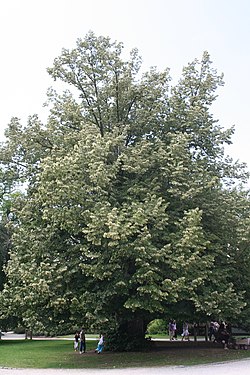
Tree in park
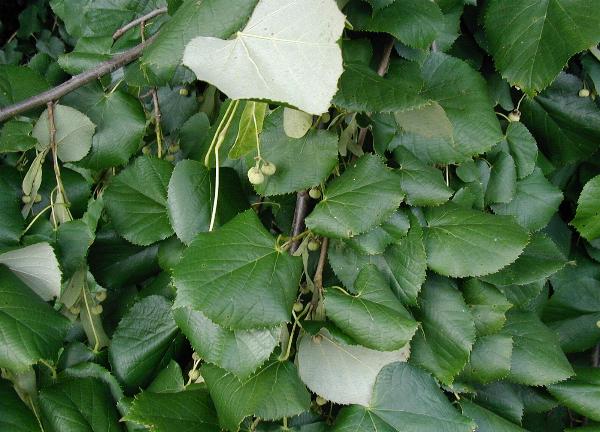

photo 1
photo 2
photo 3


References
- Standard Cyclopedia of Horticulture, by L. H. Bailey, MacMillan Co., 1963
External links
- w:Tilia tomentosa. Some of the material on this page may be from Wikipedia, under the Creative Commons license.
- Tilia tomentosa QR Code (Size 50, 100, 200, 500)
- ↑ 1.0 1.1 1.2 1.3 Rushforth, K. (1999). Trees of Britain and Europe. Collins ISBN 0-00-220013-9.
- ↑ Flora Europaea: Tilia tomentosa
- ↑ 3.0 3.1 Mitchell, A. F. (1974). A Field Guide to the Trees of Britain and Northern Europe. Collins ISBN 0-00-212035-6
- ↑ Mitchell, A. F. (1996). Alan Mitchell's Trees of Britain. HarperCollins. ISBN 0-00-219972-6.


